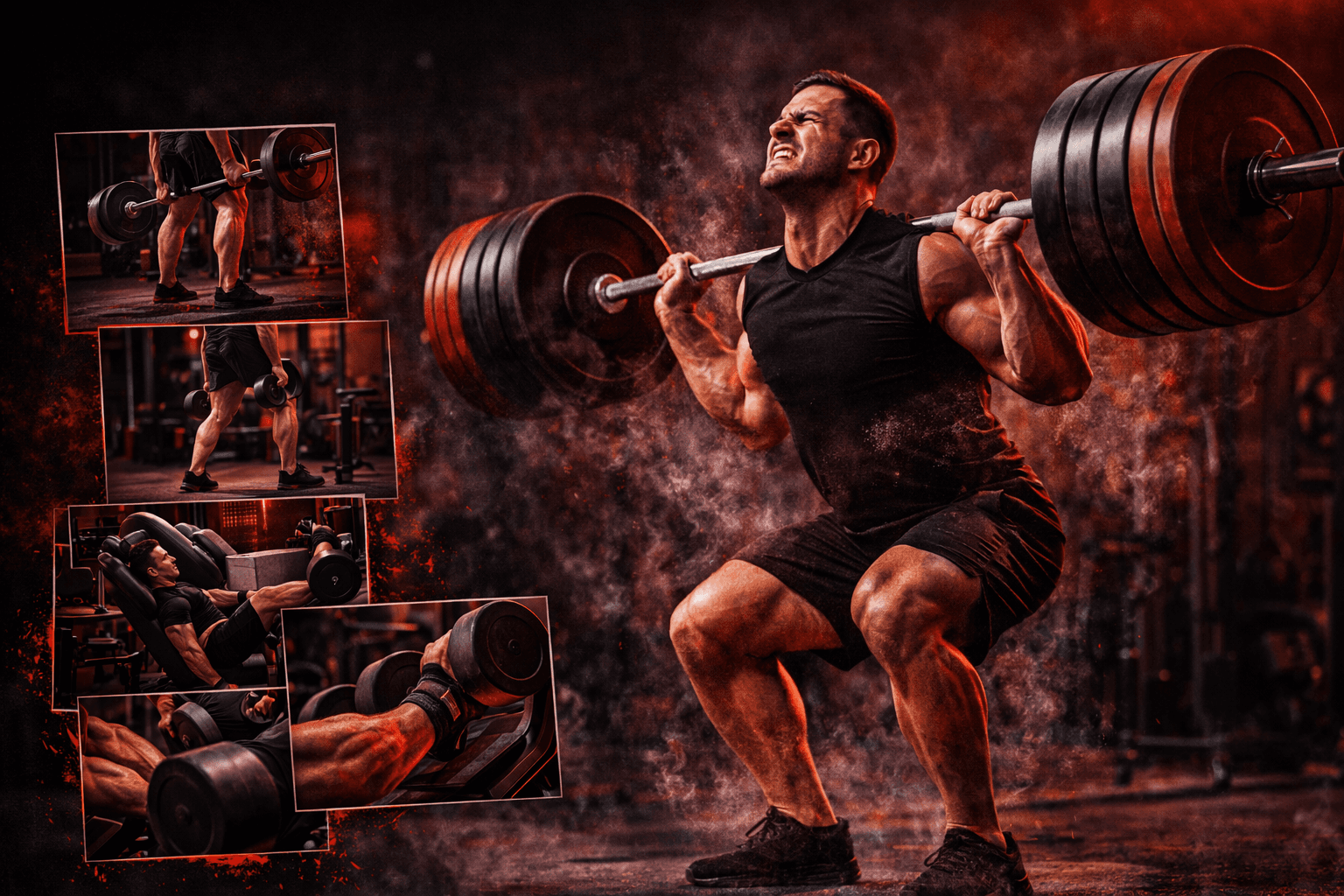
How to get bigger, stronger legs?
By Samuel Fernandez
There are no more effective methods for achieving results than those that have stood the test of time—those that have consistently delivered the desired results over the years.
When it comes to leg training for both muscle mass and strength gains, the basic principles for achieving medium-term results have been established for years. So, here's a list of adjustments you should make to your training if you want to maximize your strength and size gains.
1. FROM Squats (Full Range of Motion Squats):
Imagine you've been going to the gym for a long time and your squat numbers haven't improved much or have even plateaued. You record a video of yourself squatting and it looks more like a lizard writhing to escape from under a rock than the majestic exercise that the squat is meant to be. This is exactly what was happening to me. There was a time when the only progressive overload I was using was increasing the weight, but my poor technique not only gave me poor results but also frustration because I plateaued for a long time. I certainly wasn't on the right track. It took me a while to understand this, but I did. And when I stopped overdoing it, I adjusted my squat, lowered my head, and also reduced the weight on the bar. I worked on improving my technique, and on that foundation, I increased my numbers and the results came.
1.1. High Bar:
Put the bar at the base of your trapezius muscles, but not as low as powerlifters do. Why? Because using the bar higher places your center of gravity closer to the center of your feet, allowing you to use your quadriceps more effectively in your squat, along with tip 1.2, prioritizing them(the quads) over the posterior chain.
1.2. Knees Over Toes:
It was long speculated that if your knees went past your toes during a squat or any exercise involving knee flexion, your knees would suffer greatly. Today, we know that this doesn't cause any problems if your knees are healthy, and that knees over toes should actually be achieved. The greater knee flexion will significantly lengthen your quadriceps, allowing them to stimulate more muscle fibers in a single movement. This makes the eccentric phase of the movement (the most hypertrophic) more challenging, increasing mechanical tension
1.3. High heels:
Yes, exactly that, steal your girlfriend's heels, or if you don't have a girlfriend, steal your transvestite cousin's, and if you don't have a transvestite cousin, steal your mother's, but wear heels. Just kidding! Half-joking. Raising the heel of your shoes when doing squats will make your squat a beautiful movement, an art similar to the ancient Greeks. Not only will your routine be much more aesthetically pleasing, but it will also benefit the points mentioned earlier. It's no coincidence that we see weightlifters prioritizing footwear over accessories like knee sleeves and belts, and these aforementioned athletes have mastered this exercise to such an extent due to its great utility, both for its transfer to the Clean and Jerk and the Snatch, and for the strength and muscle mass it contributes to their sport.
2. DON'T DO SQUATS!!!
Yes, exactly that. If you're unable to do a squat properly, whether due to gender ideology or mobility issues (in which case, mobility work is the best approach), it's best not to do them; you'll hurt yourself. In these cases, it's best to switch to an exercise with similar biomechanics that doesn't have the limitations you'd normally have with squats. Bonus recommendations: Belt Squat, Leg Press, Hack Squat,Pendulum squats and the last one I don't particularly like, but if the machine is well-designed and in good condition, the Smith machine squat is a very good option (Cbum does it with exemplary execution).
3. Master Your Deadlift:
3.1- Don't do the sumo deadlift unless you have very long legs and back problems. Just because it allows you to lift more weight doesn't make it better than the conventional deadlift. First, correct your technique or your program.
3.2- Use a stance slightly, very slightly, narrower than shoulder-width.
3.3- Use straps. We're talking about improving leg strength and muscle mass, not showing off your grip strength. If you benefit from grip and forearm strength, and want to look like Popeye, you can do your forearm sessions daily without much time, weight, or sacrificing those last few reps you could have done if you used straps in your deadlift sessions.
3.4 Don't forget accessory exercises. These can be sissy squats, back extensions, abs work, and good mornings. You can include them at the end of each training session—not all of them, but the necessary ones. Hence the next point:
4. Mindful Programming:
Programming isn't 100% of your training, but... being aware of what you're doing, how much you're doing, how you're doing it, and when you're doing it (excuse the redundancy) will keep you focused on your workouts, allowing you to get the most out of each one of them.
5. Apply the Commandments of Gains:
Progressive Overload:
- More reps with the same weight
- More weight while maintaining the reps
- More sets with the same weight
- More total weekly sets
- Greater range of motion
Mechanical tension, metabolic stress, and finally, sufficient protein
Conclusion
To develop stronger, more muscular legs, the key is to prioritize technique, apply progressive overload, use the correct exercises, and follow a well-planned program. Consistency and attention to detail in every workout will allow you to maximize your results safely and efficiently. Remember that strength and size are built step by step; don't look for shortcuts and focus on the quality of each repetition.